

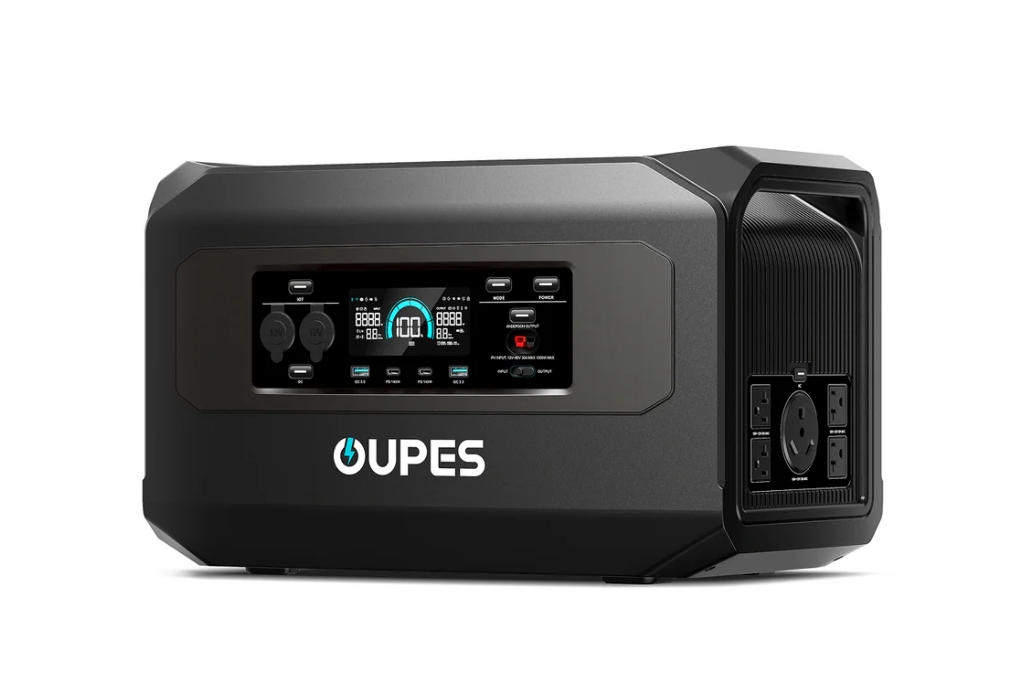
When the grid goes down in winter, theoretical specifications on a product sheet become irrelevant. What matters is performance under load, in the cold, over hours and days. This is the reality a portable power station must face, and it’s the exact scenario I used to stress-test the OUPES Guardian 6000 V2.
A three-day winter storm with sustained sub-freezing temperatures and ice-laden trees provided an unplanned, but perfect, testing ground. This wasn’t a controlled lab experiment; it was a genuine household emergency. Could a 6,000-watt, 6,000-watt-hour power station truly serve as a home’s emergency backbone? The following account details its performance, limitations, and ultimate verdict when pushed to its operational limits.
The Scenario and Initial Setup
The outage began in the early evening, with temperatures dropping into the low 20s (°F). The primary goal was to maintain critical systems: a well pump for water, the furnace’s blower and ignition system, refrigerator, a few lights, and essential electronics for communication. The OUPES Guardian 6000 V2 was positioned in a semi-insulated garage, where ambient temperatures hovered around 40°F—cold, but above its specified minimum operating temperature.
Initial setup was straightforward. The unit’s weight (over 150 lbs) necessitates a wheeled cart or two-person lift, but once in place, its multiple output ports are clearly labeled. I connected the furnace (a 1/2 HP blower motor with a high startup surge) and the well pump (a 1 HP submersible pump with an even larger surge) to the two pure sine wave AC outlets. The refrigerator and a network router were plugged into the remaining outlets via a quality surge protector.
The key was managing the “phantom load”—the continuous draw of devices even when “off.” The Guardian 6000 V2’s LCD screen shows real-time input and output wattage, which became an indispensable tool for tracking cumulative drain.
Performance Under Critical Loads
The first major test came within minutes. Starting the furnace blower and well pump simultaneously created a significant concurrent surge demand. The Guardian’s 12,000-watt surge capacity handled this without a hiccup, though the display showed a momentary spike near 4,000 watts.
Managing the Heating System
A modern gas furnace doesn’t consume much power continuously, but its cycles are relentless in cold weather. The blower motor (approx. 700-900 watts running) would cycle on for 101 minutes every half-hour. Over 24 hours, this was the single largest consumer of watt-hours, totaling roughly 1.2 kWh per day. The Guardian’s display allowed for precise tracking of this drain, confirming the unit’s inverter efficiency under a highly variable, inductive load.
Well Pump and Water Access
The 1 HP well pump was a less frequent but more power-hungry user. Each 2-minute cycle to refill the pressure tank drew about 1,500 watts, consuming roughly 0.05 kWh per cycle. Limiting water use to essentials, this amounted to about 0.3 kWh daily. The pure sine wave output proved crucial here; sensitive pump motors can malfunction or overheat on modified sine wave power, but this unit provided clean, grid-like electricity.
Refrigeration and Essentials
The modern refrigerator, once cooled, drew about 150 watts when its compressor ran. Over 24 hours, it used approximately 1.0 kWh. The remaining budget powered LED lights, phones, laptops, and the Wi-Fi router, adding another 0.5 kWh daily. By the end of Day 1, total consumption was just under 3.0 kWh, leaving a comfortable buffer on the 6.0 kWh (6,000 Wh) battery.
The Recharge Challenge in Winter Conditions
A power station’s capacity is only half the equation; its ability to recharge during an ongoing outage is the other. By the morning of Day 2, the Guardian was at 55% state of charge. I deployed three recharge methods simultaneously, as the unit allows.
- Solar Input: I connected four 400-watt solar panels (1,600W theoretical max). Under gloomy winter skies, actual input fluctuated between 200 and 450 watts. This slow trickle was valuable for offsetting the continuous phantom load but insufficient for bulk charging.
- AC Wall Charging: This was unavailable, by definition, during the outage.
- EV/Generator Charging: This became the lifeline. Using a compatible 30-amp connector, I plugged the unit into my vehicle’s tow-hitch power outlet (a 12V DC system). The Guardian 6000 V2 can accept up to 2,400 watts via this DC input. With the car running, it consistently pulled 1,800-2,000 watts, replenishing the battery from 55% to 80% in just over an hour.
The hybrid approach—solar trickle charge plus a high-power DC boost from a vehicle—proved to be the optimal strategy for sustaining power over multiple days without a traditional generator.
Capacity, Efficiency, and Real-World Runtime
Advertised capacity (6,000 Wh) and real-world usable energy are never identical due to inverter efficiency loss, battery management system overhead, and temperature effects. In this 40°F environment, I observed an effective usable capacity of approximately 5,400 to 5,600 watt-hours.
Drawing a consistent 250-watt load (simulating a few lights, a fan, and charging devices), the unit ran for nearly 22 hours before hitting a 20% state of charge, aligning closely with its rated performance. The inverter’s efficiency, which OUPES rates at over 90%, felt accurate; there was no noticeable excess heat or audible fan noise under the 300-400 watt average household load I maintained.
This efficiency is critical for long-term outages. A less efficient unit would waste precious energy as heat, shortening runtime and creating potential overheating risks in confined spaces.
Limitations and Considerations for Prolonged Use
No single device is a perfect solution. The Guardian 6000 V2’s primary limitation in a whole-home context is its finite energy storage. While it can power critical circuits for days, it cannot replace a home’s full grid connection for high-drain appliances like electric stoves, dryers, or space heaters.
Furthermore, its recharge speed, while excellent via DC or AC, is weather-dependent for solar. A prolonged storm with heavy cloud cover severely limits solar intake, making a supplemental fuel-based generator or vehicle charging necessary for a true multi-week backup plan. For users contemplating even more robust home backup, a system like the OUPES Mega 2 Pro power station with its expandable battery architecture might be a consideration for linking even greater capacity.
Finally, physical logistics matter. At over 150 lbs, this is not a “portable” unit in the sense of carrying to a campsite. It requires a planned, semi-permanent location with adequate ventilation.
Frequently Asked Questions
How long can the Guardian 6000 V2 run a refrigerator?
It depends on the refrigerator’s size and age. A modern, Energy Star-rated 18-cubic-foot fridge might use 1.0-1.5 kWh per day. Starting from a full charge (6,000 Wh), the Guardian could run such a fridge alone for approximately 4 to 5 days, assuming no other loads.
Can it start and run a sump pump?
Yes, effectively. Sump pumps have high startup surges (often 2-3 times running wattage). The Guardian 6000 V2’s 12,000-watt surge capacity can handle most residential sump pumps. A 1/2 HP pump running for 10 minutes per hour might use only 0.5-0.7 kWh daily, leaving ample capacity for other needs.
Is it safe to use indoors?
Unlike fuel generators, lithium power stations produce no exhaust fumes, making them safe for indoor use in well-ventilated areas. However, the battery and electronics should be kept in a dry location and not exposed to extreme heat. The unit’s cooling fans need clear space for airflow.
How does cold weather affect the battery performance?
Lithium batteries lose usable capacity and recharge slower in cold temperatures. Operating below freezing (32°F/0°C) can damage the cells. For best performance, keep the unit in an environment above 40°F (5°C). My testing at ~40°F showed a roughly 10% reduction in effective capacity versus ideal room-temperature conditions.
Can I plug it into my home’s circuit panel?
Not directly. The Guardian 6000 V2 is not a traditional automatic transfer switch (ATS) backup. To power hardwired home circuits (like furnace or well pump), you must use a professionally installed and compliant manual transfer switch or interlock kit with your home’s main panel to backfeed select circuits safely. Never plug the unit into a wall outlet to power your home (“backfeeding”), as this is illegal and extremely dangerous for utility workers.
What’s the best way to recharge it during an outage?
A multi-method approach is most reliable. Use solar for a continuous trickle charge during daylight. For fast bulk recharging, use the high-power DC input from a running vehicle (with the proper adapter) or a compatible portable gas generator via the unit’s AC input port.
Conclusion
The stress-test of the OUPES Guardian 6000 V2 under genuine winter outage conditions was a success. It delivered on its core promises: providing substantial, clean power to start and run critical high-surge appliances, offering transparent energy monitoring, and supporting flexible, rapid recharging. It transformed a stressful situation into a manageable one, maintaining heat, water, and food safety.
For homeowners seeking a powerful, quiet, and fume-free alternative to a traditional generator for essential circuit backup, the Guardian 6000 V2 is a compelling solution. Its true value is revealed not in its peak wattage, but in its sustained, reliable performance over time—the exact metric that matters when the lights go out and the temperature drops. While it requires an understanding of its energy limits and a plan for recharging, it stands as a robust pillar in a modern home preparedness strategy.